
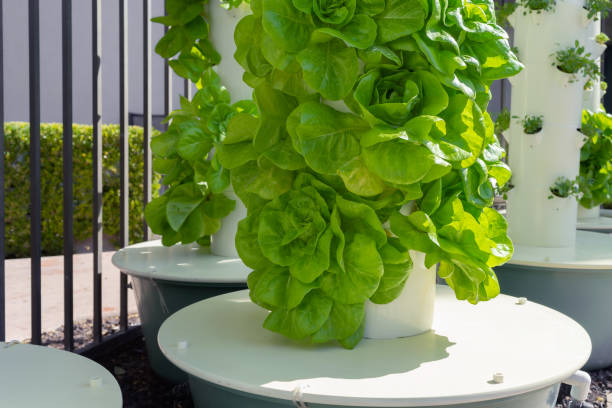
Look, most of us learned to garden the traditional way, with a patch of dirt, a garden hose, and a considerable amount of patience, so when someone tells you that a hydroponic tower garden can give you two dozen heads of lettuce from a footprint the size of a patio chair, skepticism is a perfectly reasonable response, but the good news is that the science behind a hydroponic garden is straightforward, and once you see how the pieces fit together, the whole idea starts to feel less like a novelty gadget and more like ordinary common sense.
What Makes a Hydroponic Tower Garden Different?
A hydroponic tower garden grows plants without soil. Instead of dirt, the base of each plant sits in a rockwool cube inside a net pot, and the roots dangle down into the hollow center of a tall cylinder. A reservoir at the bottom holds water and nutrients, and a pump sends that mixture to the top of the tower. From there it drips back down over the roots and returns to the tank, so the cycle repeats like a small fountain.
Traditional gardening is surprisingly wasteful when you look at it closely, because you water the soil and only a small fraction of that water, by some estimates less than five percent, actually reaches the roots while the rest runs off or evaporates, whereas a tower delivers water and nutrients straight to the roots instead, which means the plant can put its energy into growing upward rather than stretching its roots out in search of food.
Why a Hydroponic Garden Saves So Much Water
Here’s the thing about recycling water inside a closed loop: the savings add up fast. Because the same water travels up and down the tower again and again, a hydroponic garden can use around 95 percent less water than conventional farming. That efficiency is one of the main reasons these systems have become so popular in arid regions such as desert cities and parts of the Middle East, where every gallon matters.
It also benefits your household budget, since reduced water waste means lower costs and a steady supply of fresh herbs and greens means fewer trips to the produce aisle. Growers also report faster results, with some sources describing growth up to three times quicker than soil, thanks to better oxygen uptake and more precise watering.
Growing Up Instead of Out
Picture a commercial lettuce farm for a moment, where a single head of lettuce can occupy a full square foot of field. A tower garden turns that math on its head by growing vertically, so in under three square feet you can fit 24 heads of lettuce or more. That works out to roughly eight times the yield per square foot, which is a remarkable difference for anyone short on space.
This is precisely why towers appeal so strongly to apartment and condo dwellers, since a balcony is precious real estate and you probably want to keep room for a grill and a couple of chairs. A tower takes up about as much space as one of those chairs, and if yours comes with grow lights, you can skip the balcony altogether and set it up in a spare corner indoors.
Getting the Watering Schedule Right
The most common question new growers ask is how long to run the pump. A reliable rule of thumb applies if your seedlings were started in rockwool: run the pump for 15 minutes, then rest it for 45, for about 14 to 18 hours a day. Use fewer hours when it’s cool and more when it’s warm. If you started your seeds in sponge cubes, which don’t hold water as well, plan on a tighter rhythm of 15 minutes on and 15 minutes off, around the clock.
Treat those numbers as a starting point rather than a strict requirement, because mature plants have larger root systems that retain moisture more effectively and can therefore handle longer gaps between waterings than seedlings can. The most appealing part is that an inexpensive timer manages the entire routine, which eliminates hand watering completely.
Lighting Your Hydroponic Garden Indoors
Plants need both water and light, and light is the more difficult one to supply indoors, because grow lights used to be expensive and power hungry until LED technology began to change that around 2008. Modern LEDs last for tens of thousands of hours and use a fraction of the energy that older bulbs required, which makes an indoor hydroponic garden far more practical than it once was.
A timer works nicely here too. For indoor growing, run the lights 12 to 16 hours a day, followed by 8 to 12 hours of darkness, and keep that schedule consistent. Plants really do notice, and a regular dark period matters more than most people expect. When you compare setups, look for lights that cover the tower from top to bottom and side to side, and that can be rotated or moved closer to young seedlings and farther away as they grow. Broad spectrum white LEDs are a solid all-purpose choice, and fruiting crops like tomatoes and strawberries will want more light than lettuce does.
Check the Plastic Before You Buy
It’s easy to look at a tower and see nothing more than a plastic tube, but the specific type of plastic matters considerably because your food will be in constant contact with it. Food safe plastics include numbers 1, 2, 4, and 5 on the recycling chart, which are PETE, HDPE, LDPE, and polypropylene. All four are BPA free. Before you commit to any hydroponic tower garden, check which plastic the manufacturer actually uses.
What You Can Grow, and What to Skip
Leafy greens, herbs, and many fruiting plants thrive in a tower, and lettuce, spinach, kale, basil, parsley, tomatoes, cucumbers, peppers, and strawberries are all excellent candidates. The notable exception is root vegetables, since carrots, potatoes, and onions grow downward and the internal components of the tower obstruct their development.
Is a Hydroponic Garden Worth It?
For most home growers the answer is yes, particularly because produce begins losing nutrients within about a day of harvest, so picking greens minutes before dinner is difficult to beat, and you also control exactly what goes on your plants, with no pesticides or herbicides, while the savings on store bought herbs and greens can add up over time.
It’s worth being honest about the limitations, though, because running one or two towers at home is easy while scaling hydroponics to an industrial farm takes serious investment in equipment, plumbing, and electrical work, which is why soil farming isn’t going anywhere soon. For micro farming at home, however, the model already works beautifully.
Final Thoughts
A hydroponic garden won’t replace every vegetable bed, and it doesn’t need to. What it offers is clean, automated, space efficient growing that anyone can manage, even without gardening experience. If you’d like to see how all of this comes together in a single system, take a look at this hydroponic tower garden from ALTO Garden. Set your timers, start with a handful of herbs and lettuce, and you could be harvesting within a few weeks.
